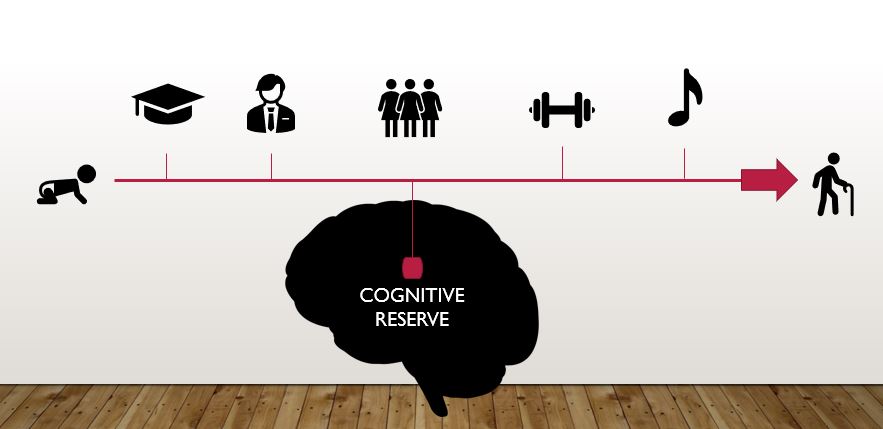
| Abstract Body | Cognitive reserve (CR) is known to reduce or even protect against the negative effects of aging on cognitive functioning. CR has also often been associated with compensatory mechanisms related to executive functions (EFs), which in turn can be affected by depression.
The aims of the present study were to investigate whether CR proxies (i.e.,Education, Working Activity and Leisure Time) moderated threlationship between age and EFs. Additionally, we explored whether Depression moderated the relationship between CR and EFs.
A cross-sectional design assessed a sample of 110 adults older (Age= 46.18 ± 6.7). CR proxies were estimated using the Cognitive Reserve Index Questionnaire. Depression was assessed with the Patient Health Questionnaire-9. To estimate EFs, a composite score was computed by using three cognitive tests.
A series of Hierarchical regression models were used to investigate the potential modifying effect of each CR proxy in the association between Age and EFs, after controlling for gender, in the whole sample. Additionally, similar analyses were performed to investigate the potential role of depression in moderating the association between CR proxies and EFs, after controlling for age and gender, in young and older adults.
Among all CR proxies, both Education and Leisure time moderated the association between Age and EFs, indicating a decreased positive effect of these CR proxies on EFs with age. Age predicted EFs in both models. Moreover, Depression moderated the relationship between Leisure Time and EFs in younger. Lower scores in Depression were associated with greater EF performance. Leisure time showed protective beneficts for EFs, particularly in highly depressed younger adults. Overall, this study showed the significant role of Age and CR in influencing EFs and a limited role of Depression in moderating the association between CR and EFs. Further research utilizing different measures of CR (or mood) is required to elucidate the associations.
|
|---|