
| 021-22 | |
| Rapid time scale microstructural changes in the human brain during learning new language | |
| Sahal Alotaibi | |
| University of Liverpool | |
| The Abstract | |
| Abstract Body | Advanced neuroimaging technologies such as Magnetic Resonance Imaging (MRI) disclosed human brain plasticity after learning new cognitive or motor skills. Data from language learning research confirmed that, microstructural changes depends on the training period and distinct according to the type of lingual task. For instance, rapid neural changes found after a short-term course of learning lexical tasks. Here, we use pre and post-training diffusion tensor imaging (DTI) to examine the impact of learning new articulation items from a new language (L2). Forty-six healthy English-speaking participants were taking part in training courses of one hour per day for three consecutive days. The subjects were divided into two training groups; spoken language group to learn new speech sound from Arabic language, and sign language group to learn new sings from British Sign language (BSL). The behavioural results for each group show significant improvement in speaking and signing performance. Imaging analysis reveal changes in DTI measures in white matter tracts within language-related brain areas after training. We also observe that, these microstructural changes appear even in absent of vocal speech sound in the sign language training group. These finding provides additional evidence of rapid training-induced neuroplasticity after only three hours of training. |
| Image 1 | 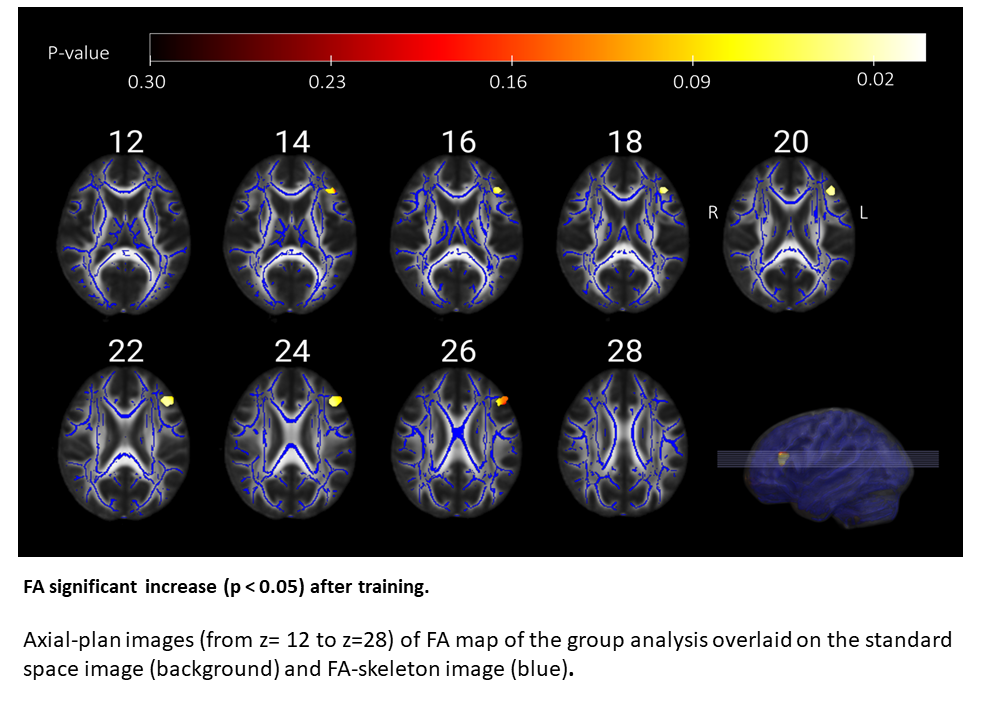 |
| Additional Authors | |
| Georg Meyer | |
| Sophie Wuerger | |
| Additional Institutions | |
| Taif University |
021-22 – Rapid time scale microstructural changes in the human brain during learning new language
Written by
in